Interview
Passing the Baton of Technology and Passion
A Young Team’s
DMS Development Story
(Part 1)
A Driver Monitoring System (DMS) enables driver alerts and vehicle control functions by detecting drowsiness and distraction from the driver’s facial expressions and gaze direction. Mitsubishi Electric Mobility Corporation announced the industry’s first* wide-angle camera-equipped DMS in 2017. Since then, we have continuously refined and improved our technologies in order to achieve even more advanced preventive safety.

The high quality of our DMS products is not achieved by a single department alone. It is the result of teamwork. The development team pioneers new technologies, the design team translates them into a foundation for mass production, the manufacturing team refines them on the production line, and the sales team delivers them to customers. This relay—passing the baton across functional boundaries—is the driving force behind Mitsubishi Electric Mobility's DMS products.
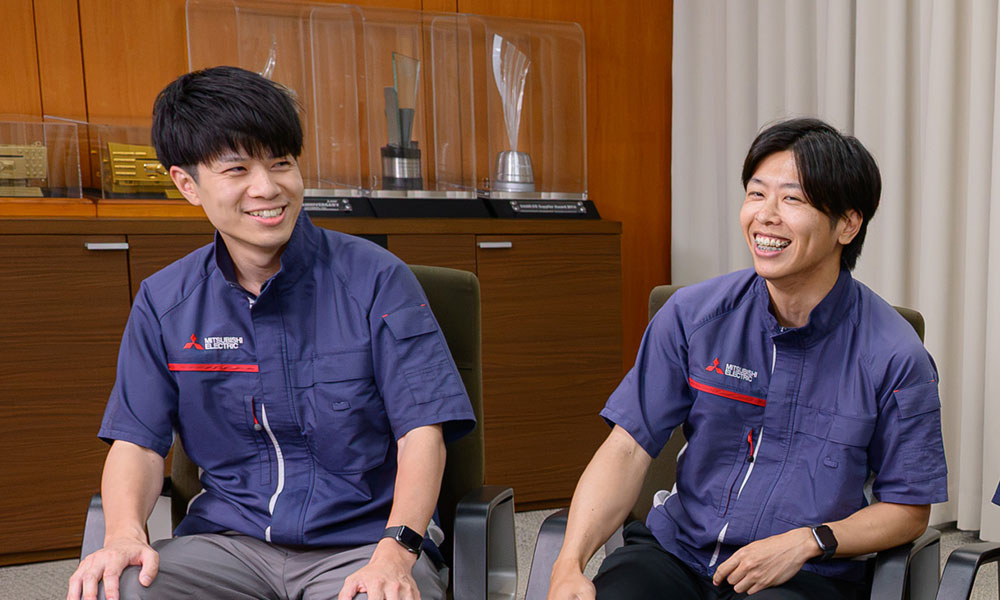
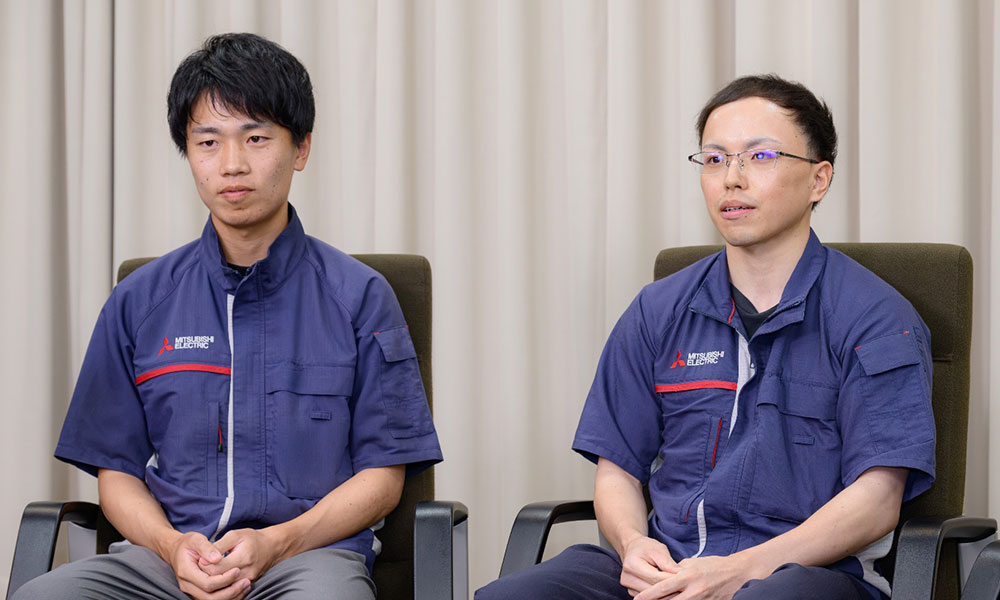
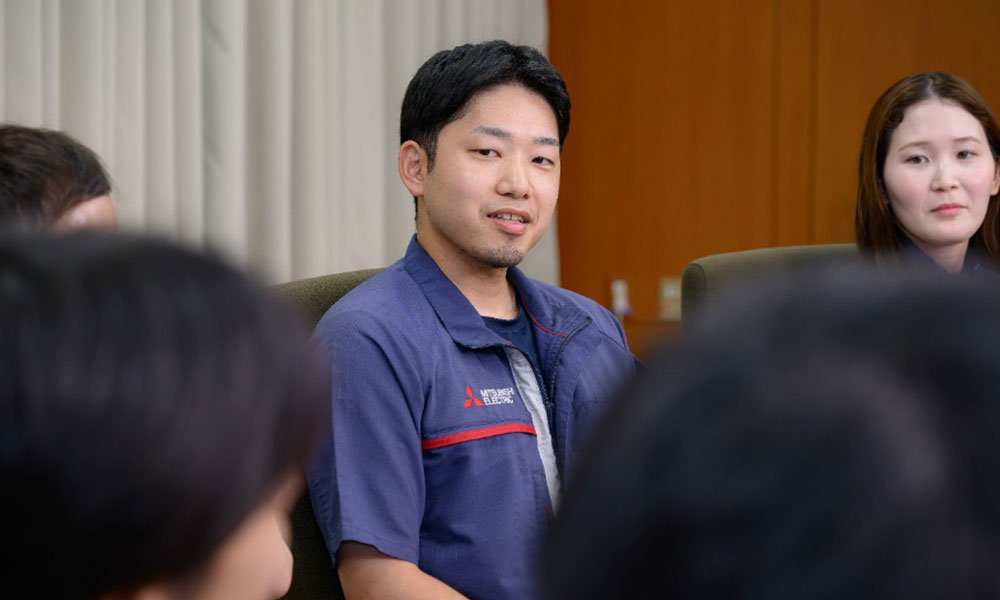
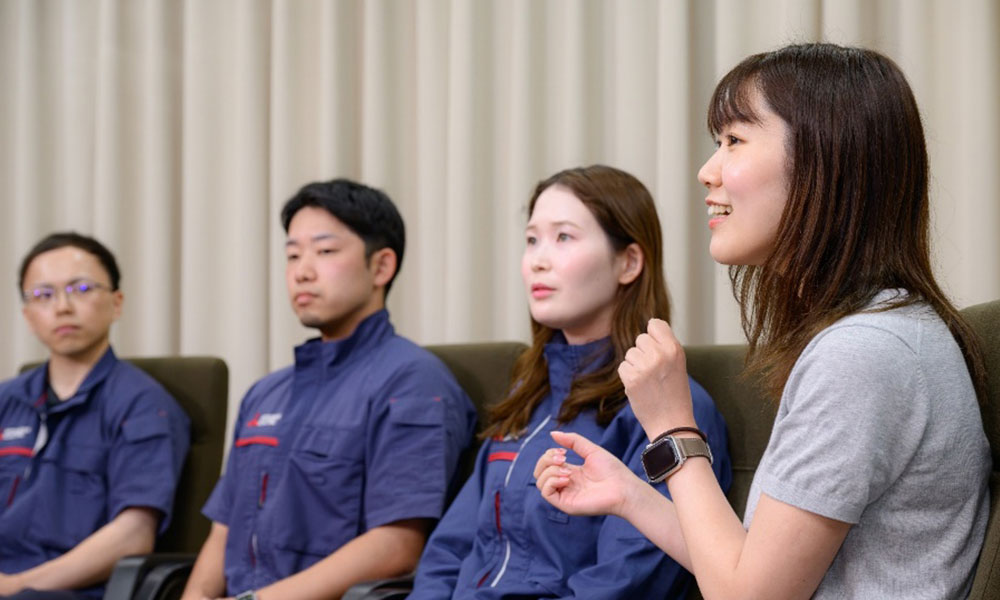
We interviewed seven young employees who are committed to the advancement and dissemination of DMS. Across this two-part series, they share their enthusiasm and pride in their roles, as well as their vision for the future. In Part 1, we focus on the “monozukuri relay,” in which the baton is passed from the development team to the design team, the manufacturing team, and the sales team.
*As a wide-angle camera-equipped monitoring system, based on our research.
Talk Members
-

IP Administration
-
Development -
Design -
Manufacturing -

Quality Control
-
Sales -

Customers
Communications with Development Team to Support Sensing Technologies
DMS is the embodiment of Mitsubishi Electric Mobility's comprehensive strengths. Could you tell us how this project progresses, how the teams work together, and what role you play in it?
- Development
- Murachi
My primary responsibility is developing biosensing technologies for DMS. In addition, I examine ways to better meet customer performance requirements, and I am involved in the entire process of preparing DMS for mass production. This includes the preparation and standardization of various documents to ensure the quality of the final product. As a sales engineer, I also frequently join Ueda-san and other sales colleagues in customer meetings. Furthermore, I often work with the hardware team on quality improvement, meeting with Design Section-A, where Yamasaki-san works, two or three times a week.
- Design
- Kagawa
That’s because not every problem can be solved by software tinkering alone as DMS evolve.
- Development
- Murachi
Exactly. Since we entered the DMS market in 2018, sensing technologies have evolved considerably. As a result, it reached the level where, as well as biological information, heart rates and blood pressures can be monitored. However, if we aim to go a step further, it is imperative that software is more closely connected to hardware and structures, such as the structure of cameras and design of filters. In order to achieve our goal of “delivering better products to customers,” I believe that communication across divisions will be increasingly important.
- Design
- Kagawa
Additionally, our software design, hardware design, and mechanism design teams are all involved in development as they demonstrate their expertise. The strength of a system as a whole also leads to the quality of our DMS. In this project, I am in charge of the design of the entire software systems for DMS, including sensing technologies developed by Murachi-san’s team. Sensing technologies are used for detecting and determining the driver’s drowsiness and distraction from images captured by a camera. When these signals are received by an electronic control unit (ECU), a system alerts the driver. I am involved in designing those systems for DMS to conduct those tasks.
Kagawa-san, is your section often involved with Kuwahara-san’s Manufacturing Engineering Division?
- Design
- Kagawa
Yes. We frequently make sure that our understanding is aligned between the software team and the manufacturing team. While we have constraints, such as development costs and takt time, we need to find a compromise between the ideal on the software development side and the reality on the production site. That’s a difficult point. In most cases, we usually make adjustments to software because it is more difficult to make alterations to hardware.
- Manufacturing
- Kuwahara
I feel bad about making unreasonable demands of the software division all the time. I would be grateful if you could understand that all those demands are suggestions for better products in a better way (laughs).
Communication Between Development Team and Manufacturing Team to Meet Customers’ Demands for Smaller and Discreet Products
- Design
- Yamasaki
As Murachi-san said earlier, my department is responsible for hardware design and coordination, while working with the DMS sensing division. In that role, I am involved in the entire process from considering the system configuration in the early stage of development to mass production. Working with the procurement division, I select components and develop cost-reduction measures. My responsibilities extend over diverse areas, including working with the manufacturing engineering division to improve yield by optimizing inspection standards. When the project enters the business negotiation stage, I work with the sales to negotiate costs. Communication with a wide range of people may be one of the defining features of this role.
What sort of requests do you often receive from automaker customers?
- Design
- Yamasaki
DMS cameras are located where they are easily visible to the driver, so we often receive requests from customers to make the DMS cameras as small and discreet as possible. This is Taguchi-san, who examines the manufacturability and potential manufacturing issues associated with making the DMS smaller.
- Manufacturing
- Taguchi
It is technically possible, but if we try to simply reduce the size of a housing, there could be more than a slight problem arising. It is also my responsibility to report those issues back to the design team during the prototyping phase. I am also working mainly on improvement of productivity and quality on production lines. You may think it is a job for the quality assurance division, but my role is more closely connected to the production floor. When any defect occurs, I will find out the extent to which it could affect the production line. In those cases, my tasks also include checking with the design or manufacturing engineering divisions about matters that cannot be determined on the production floor, as well as sharing information with the quality assurance division. In short, I am in charge of acting as a bridge between the shop floor of manufacturing and the quality assurance division.
- Sales
- Oiwa
I am a sales representative working at a branch, so I am not very familiar with the production floor. What kinds of things can lead to defects on the production floor?
- Manufacturing
- Taguchi
Some defects are equipment-related, while others occur at the individual component level. Manufacturing processes could cause defects. Our mission includes minimizing the impact of defects and developing systems to prevent them from occurring in the first place.
From Creators to Deliverers──When a Baton Has Been Passed on
- Development
- Murachi
I feel that our awareness of the quality of the entire project has grown thanks to Taguchi-san.
- Manufacturing
- Taguchi
As a person in charge of quality improvement, I consider it part of my role to raise the awareness of everyone involved in the DMS project. So, I am very pleased to hear that.
- Manufacturing
- Kuwahara
Taguchi-san said that he reports the issues in the prototyping phase back to the design team. It is our responsibility as the manufacturing engineering division to stabilize the manufacturing infrastructure from prototyping through the transition to mass production. The manufacturing engineering function covers three processes: namely, mounting, assembly, and inspection. I oversee the inspection equipment. My responsibilities are the design, development, and setup and launch of inspection equipment for DMS. To achieve the reliable and efficient inspection of products, I am seeking the best inspection methods and equipment specifications daily, while working with the design division.
As you work to improve efficiency, I understand that you sometimes have enthusiastic discussions with the design division.
- Manufacturing
- Kuwahara
For the company to increase profits, what we, the manufacturing engineering division, can do is to improve production efficiency, as well as to keep equipment costs down. In either case, we cannot achieve it without the cooperation of the design, manufacturing, and quality assurance divisions. In particular, Kagawa-san joined the company in the same year as me, and we have been working together on DMS projects for some while. This makes it easy for us to frankly speak without sugarcoating, which I believe is having a positive impact on this project.
- Development
- Murachi
Ueda-san and Oiwa-san propose DMS, which was created through collaboration between the research and development and manufacturing teams, to customers and work to promote the wider spread of DMS.
- Sales
- Ueda
Yes. My responsibility is to promote DMS sales to customers other than automakers. More specifically, my customers include insurance companies, dash-cam related businesses, car leasing companies, and car rental agencies. As Yamasaki-san talked about requests from automaker customers earlier, there are still no specific needs for DMS in the industries that I am in charge of. Therefore, my activities center around proposal-driven sales to create demand through our proposals.
Working Across Departments Before Saying “No”
I guess, in proposal-driven sales, there must be a big difference in customers’ level of interest in DMS when they don't have a specific need for it.
- Sales
- Ueda
Yes. Some customers already have an understanding of the purpose and benefits of introducing DMS, while others are not familiar with DMS at all. There are also customers who know about DMS but have not yet been able to envision the benefits of introducing it or how it could be used. As I listen to the voices and needs of these diverse customers, I often consult Murachi-san, for example, about features that could be incorporated into DMS and the trade-off between functionality and cost.
- Development
- Murachi
Expansion to non-automaker customers is a new business strategy for DMS, which means our entry into new areas/industries where we have no experience. What can DMS achieve, and what benefits can DMS provide for diverse customers? Ueda-san always asks for ideas that answer these questions. By addressing these questions, we are motivated in development.
- Sales
- Ueda
Oiwa-san, as you are in charge of sales to automakers, what do you keep in mind when dealing with customers?
- Sales
- Oiwa
As you all know, sales activities for automakers center around working out specifications with customers, managing deliveries, preparing estimates, and obtaining orders for new deals. While conducting these tasks, I make a point of not saying “no” to a customer’s request on the spot. Even for atypical requests that are difficult to fulfill, I try first to consult the team members here in charge of development, design and manufacturing engineering. Many of the consultations concern cost. The specifications of DMS can be altered according to what features each customer requires. I think that flexibility in terms of costs is another unique advantage of Mitsubishi Electric Mobility.
- Design
- Kagawa
We in the development team are also continuously working on cost reduction, for example, by sharing common features to reduce development hours and by accelerating algorithms. In addition, I believe that aligning the features with customer requirements, as Oiwa-san mentioned, is also an important factor in enhancing our price competitiveness. Instead of giving up when a customer says that a product is too expensive, we work to find a practical balance between the ideal and what is feasible—for example, by explaining, “At this level of functionality, we can achieve it at this price.” We also make these adjustments with the customer’s perspective in mind.
From development team to design team, manufacturing team and sales team. Part 1 showed how the team members pass the baton toward a single goal, while viewing the same goal from the unique perspective of each function. In Part 2, we will focus on the value created by DMS, as well as the team’s passion.
- 1
- 2
*The article, division and department affiliations, and photographs reflect information at the time of the interview.
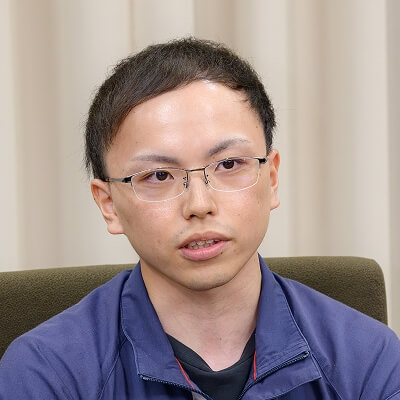
Development
Ryohei Murachi
Joined in 2018. Design-F Section, Sensing Equipment Design Department. In charge of the development of sensing technologies used in DMS and setting-up for mass production.
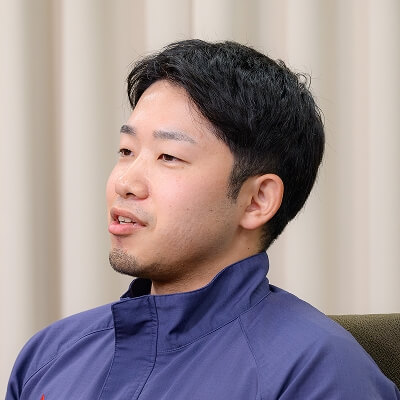
Design
Tomohiro Kagawa
Joined in 2021. HMS Business Project Group. In charge of overall system design for DMS software.
Design
Sota Yamasaki
Joined in 2023. Design-A Section, Sensing Equipment Design Department. In charge of design and coordination of DMS hardware.
Manufacturing
Kandai Taguchi
Joined in 2017. Sensing Equipment Production Section, Sensing Equipment Design Department. In charge of productivity and quality improvement of DMS production lines.
Manufacturing
Masashi Kuwahara
Joined in 2021. Manufacturing Engineering-A Section, Manufacturing Engineering Department. In charge of the design of DMS inspection facilities and the construction of production platform for mass production.
Sales
Chieri Ueda
Joined in 2022. Strategic Planning Section, Strategic Planning Office, Sensing & Service Solutions Business Unit. In charge of new customer sales except for automakers.
Sales
Rina Oiwa
Joined in 2025. Account Sales Section.A, Utsunomiya Office, Saitama Sales Office. In charge of overall sales activities targeting automaker customers.